

Well hello again, and welcome to our final film of our “Summer Forever” strand at Cine Club. Not only does it feel great to provide people a safe place to escape from the heat, but ironically this has been a season of absolute heaters, of which The Last of Sheila is no exception. You can still grab tickets here or at the door, plus I can finally reveal our next slate, as Cine Club enters year two! In September, as a pairing with our wonderful Cecilia Fiona exhibition, we will be screening Interstellar. Tickets aren’t on sale yet, but keep your diary open for Thursday 17th September. The rest of the programme will also go on sale at a similar time, I’ll save those surprises for you to discover yourself, but I will say that our next season is called Elastic Reality. Lots to look forward to then, hopefully we’ll see you there!
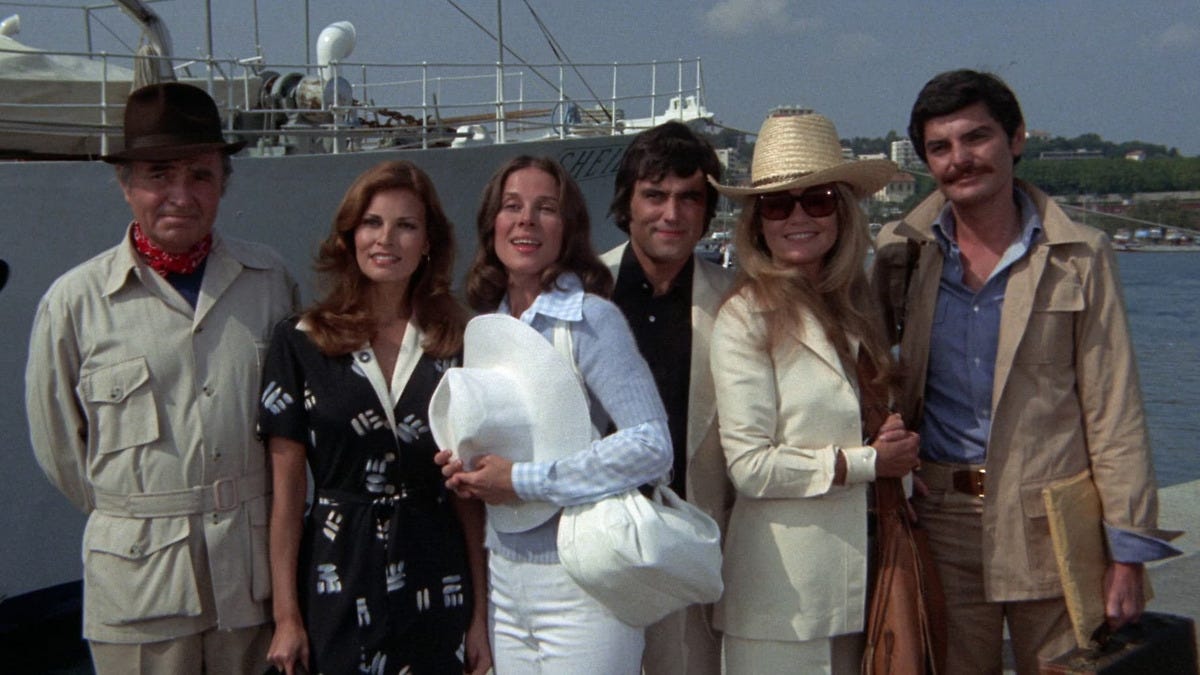
Three years ago, a full fifty after its original release, The Last of Sheila was released on blu-ray in the UK for the first time. I appreciate that on the surface this may not sound like a particularly earth shaking moment, but it was one of those releases that saw a long forgotten classic resurface from the depths of lost media. I had actually been recommended the film in 2018 by the film critic Alan Jones, so it had been on my radar but out of reach for at least a few years, and now it is back. Reader, if you are one of those people who wasn’t around for the film before it vanished, make now your opportunity to discover the film Molly Haskell called “A camp thriller about the dirty little secrets of commies and perverts on a Mediterranean cruise”.
The Last of Sheila is a murder mystery, though not quite in the vein of the usual Poirot fare. There is no central detective unravelling the mystery, instead it’s a group of people who are both suspect and potential victim. Formally it’s sort of closer to And Then There Were None, though without the sheer bloodshed of that. It’s a notable deviation, as this film comes just before the huge wave of murder mystery films and TV shows in the seventies and eighties. Columbo had debuted a few years earlier but otherwise, The Last of Sheila premieres before Magnum PI, Murder She Wrote or the Sidney Lumet adaptation of Murder on the Orient Express, which starred Sheila co-writer Anthony Perkins. When we think of murder mysteries now, these are the lenses through which we view them, which is why I think it’s so exciting to watch something that exists before that wave.
Of course, the other major murder mystery franchise of our current era is the Knives Out franchise, which Rian Johnson has admitted is very indebted to Sheila. Without going too deeply into spoilers, I think there are ways in which each of the three films he has made are influenced by the structure and narrative of Sheila. There is the obvious connection in Glass Onion, a film set on the Mediterranean and which features lots of arrogant rich people bickering. It’s the less obvious connection I love though. All four of these films are tricksy with how they present their murder. Every single one of these films is a true and honest murder mystery. Someone will be murdered and someone will be outed as the murderer, but it isn’t as simple as A to B. In the original Knives Out the mystery is “solved” halfway through, in Glass Onion the inciting murder appears to be very late in the narrative and likewise, Sheila is sly about whose murderer will be unmasked. It’s playful, but in the true sense of play. You can solve it, you can “win”, but you are going to have fun on the way there.
That sense of play in Sheila feels like it must come from its inception. This is for my money one of the most delightful origin stories of how a film got to be made. Essentially, Stephen Sondheim (as in, the writer and lyricist behind West Side Story, Sweeney Todd and Merrily We Roll Along) and Anthony Perkins (yes, Norman Bates himself from Psycho) used to throw parties for their showbiz friends. At these parties, the two of them would host murder mystery parlour games, elaborate affairs all constructed to entertain their crowd. One of the guests at these parties would turn out to be Hollywood director Herbert Ross, who asked the two to turn these games into a screenplay. Gamely, they obliged, and Ross directed the screenplay that became The Last of Sheila.
If I could, I’d like to end by introducing you to a term you may not know. In the wrestling community, there is a word called Kayfabe. It’s the idea that, despite everyone involved knowing that the events they are going to see are scripted (as in planned out, not staged!), all involved still maintain the suspension of disbelief. The fourth wall has been knowingly lowered, but audience and participant engage in imagining the wall is there regardless, creating a heightened atmosphere in which reality and fiction play together. Bizarrely, that is the word that came to mind for me with The Last of Sheila. The conceit is a game, a group of friends are here to play. At a certain point though, it becomes unclear what is game and what is deadly reality. I’m sure the characters wouldn’t consider it “kayfabe”, but as a viewer it feels so. The lines between game and truth become not just blurry but near non-existent, and yet we as the audience embrace that. It creates a glee even in the darker moments, adds a tension even to the fun. It’s playful and it’s camp and it’s brilliant.
Despite the place murder mysteries now occupy in society as cosy tales for solo consumption, I think it is crucial that films like this still find home on the big screen. The Netflix era Knives Out films are great, but I’m so glad I got to see them in a cinema and not just on my sofa. The same is true of The Last of Sheila. If you can’t make it tonight, whether your schedule doesn’t work or you just don’t live feasibly close to Eastbourne, ask your local independent cinema about this film. Films like this should be shared and if you can’t come and share tonight, share with your local community. Have a grand old time at the movies for Gods sake.
If You Like This, You’ll Like…
Films:
Clue (1985, dir. Jonathan Lynn) – Decidedly sillier than The Last of Sheila, Clue is that rare thing: not just a film adaptation of a board game, but a fantastic adaptation at that. There’s a murder mystery, sure, but it’s a gorgeously loose framework to hang jokes off of, all leading to one of three cheeky endings.
Video Games:
The Return of the Obra Dinn (2018) – Need another hit of boat based murder mystery? Here’s something a little special. You arrive on a boat thought to be lost, and must work out what happened to the crew by examining tableaus at the moment of death. It’s technically insurance work not detective work, but it ignites that grey matter all the same.
Duck Detective: The Secret Salami (2024) – Detective work doesn’t all have to be based on grisly murders and deaths, what if there was a narrative based on who stole someone else’s lunch at work? This is anthropomorphic nonsense of the highest order, a treat you could blast through in an evening.
 The Quite Nerdy Blog