
Happy July everyone, I hope you’re holding up as best you can in what has been a disgustingly hot summer here in the UK. Fortunately, it is a truth universally acknowledged that the cinema is a wonderful place to be during this time of year because almost all of them are air conditioned. Should you be in search of such a venue this week, how about popping along to our screening of City of God tonight? Tickets are still available here or on the door, but if that’s not your thing, you still have time this summer to catch the wicked The Last of Sheila on the 6th August.
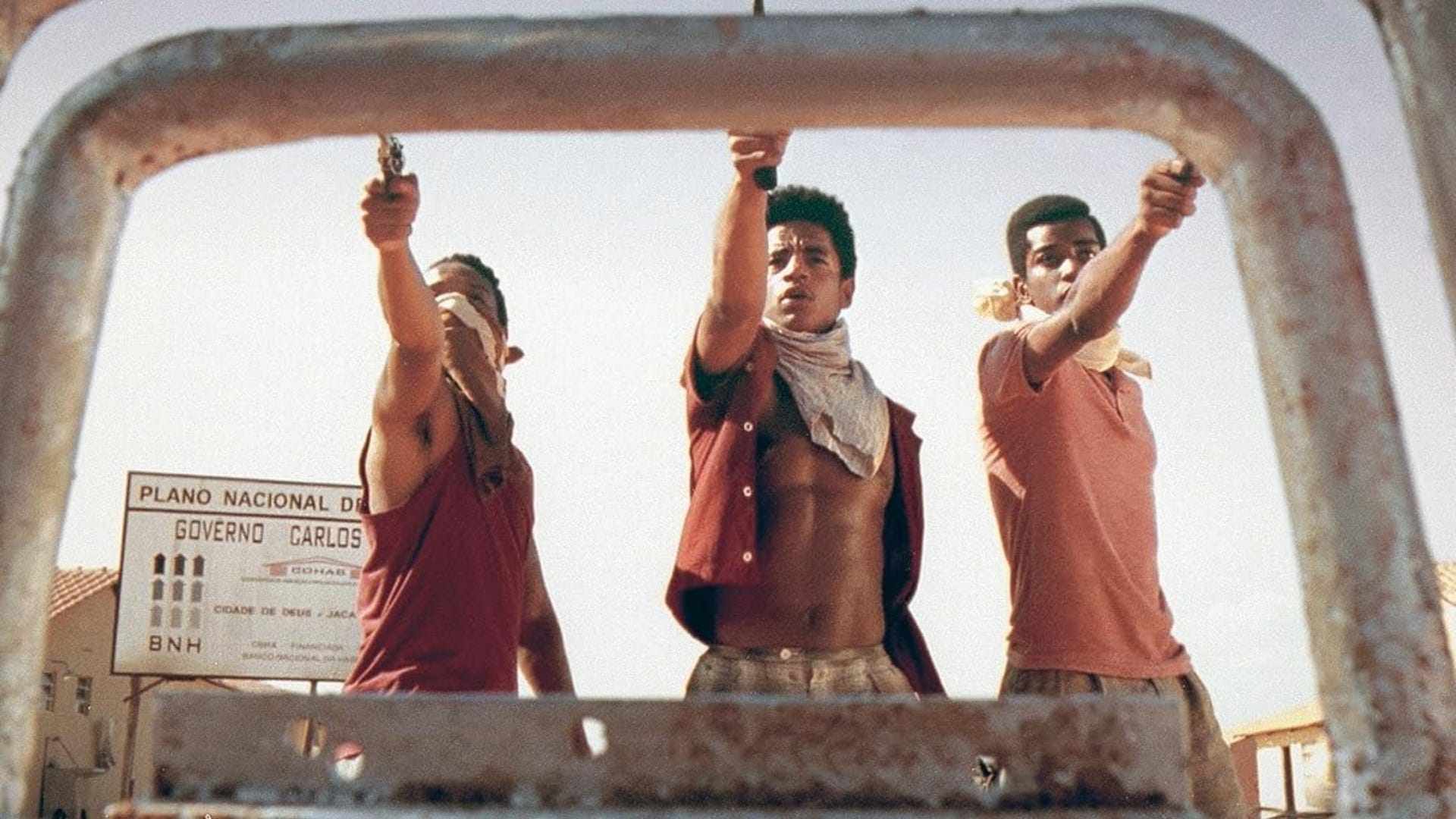
Depending on your social circles, you are one of two people. You have either never heard of City of God, or you have heard that it is one of the greatest films of all time. For my generation of cinephile, raised in the world of the DVD and stewed in the world of Imdb and Letterboxd (where it is respectively the 26th and 10th highest rated films on the platforms), this is what we could call a core text. Take me, for example. I saw this in my second year of sixth form film studies, a time where I was interested in international cinema but didn’t know where to begin. As a 17 year old, it was a perfect starting place, but regardless of age this is one of the best entry points to foreign language cinema, because while it shows a place and a community that feel foreign to those we may know in the UK, it is told in a style that is immediately recognisable to us.
The big phrase always thrown around with City of God is that it’s “the Brazilian Goodfellas”, a take on the classic Martin Scorsese film that takes place in South America instead of North. You can see the comparison points, certainly. Both are crime sagas that take place over multiple decades, both tell their story using rigorously impressive camera techniques and both are based on a true story, something that both films don’t explore fully until their final moments. It’s a convenient shorthand and an easy elevator pitch to the sceptical, but on returning to this film I found that the film it most reminded me of was Paul Thomas Anderson’s Boogie Nights. Though Anderson’s film is a fiction story, it still shares the scope and technical heft of City, and most importantly shares a really exciting handling of tone. Both films have incredibly joyous highs and really scary lows, the latter of which tend to come from a scorned and slightly crazy man with a gun. It’s not as catchy as “Brazilian Goodfellas” but the point at least remains that the few comparison points are incredibly impressive films to compare anything to.
As viewers outside of Brazil and presumably without much of a knowledge of Brazilian history, City of God is a fantastic evocation of a time and place we may not know. The European view of Brazil, specifically Rio, is of the beaches and the beautiful people, all of the non-stop parties that we assume go on there. There is an assumption that there’s a darkness underneath that, of course, but the glamour is the first thought. City brings us straight into that darkness then, making the poverty and crime of the story unignorable. Never oppressive, but always part of the story. This is a period recently characterised in The Secret Agent as “a time of great mischief” and that feels true to the story of City, in which the drug dealers are plenty corrupt but so are the police who are supposedly chasing them down. Small details do a lot of heavy lifting with it. One of my favourite things is in a dance scene in the film, you can tell the disco ball is just a football wrapped in tinfoil, I think that’s a wonderful detail. In a funny twist though, the seventies setting is clear, but so is the fact that this is a film from almost 25 years ago. The editing paired with the spinning camera makes certain scenes feel bizarrely reminiscent of a film from the Saw franchise, in a not off-putting way! It’s just something about the film that charms me, that it’s a period film that in its construction is also an evocation of a period gone by.
Part of what makes the film feel so authentic is its performances. The cast includes a few professional actors, of whom Alice Braga is best known to English language audiences and Matheus Nachtergaele is best know to Brazilian audiences, but is mainly comprised of first time actors, many of whom grew up in the “City of God” area of Rio. Some of these actors are absolutely breath-taking, which we can certainly give some credit to the cinema verité casting technique but which requires us to still acknowledge immense talent. Lead actor Alexandre Rodrigues manages to carry the entire film as a first time actor and never stumbles under that pressure, but if I am to highlight one of these actors, it would have to be Douglas Silva, the young actor who plays Li’l Dice. Many actors make careers out of playing villains, and yet here is a child actor who has nailed it out of the gate. He’s terrifying in the same way that Hannibal Lecter is, totally compelling but utterly horrible. I’d of course be remiss not to mention the appearance of Seu Jorge, most well known as a singer but who had a very memorable role in The Life Aquatic with Steve Zissou, where he sang Portuguese language covers of David Bowie songs. These are two very different performances, he’s subtly brilliant in both.
Finally, I’d like to just touch on how the film approaches storytelling as a theme. It has a stories within stories structure that I’m sure some would criticise as a Pulp Fiction homage, but I find to actually be a dedication to the act of journalism. You see, I have buried the lede here. City of God is based on a true story, and does not announce itself as so until the closing credits. Sure, the marketing material of the time was not shy about this information, but I think that if you can make it to the film without that knowledge, it plays as a pretty special reveal. In that sense, the film is constantly working to unveil bits of information it has not yet disclosed to you, often presenting them as “The Story of…” Information is not so much hidden from us as it is saved for a more interesting moment in which that knowledge is more pertinent. In Rocket, this theme emerges too. While everyone else he knows is dedicated to creating their story through violence, Rocket captures the story through his camera. It certainly can’t be accidental that we have the double entendre of shooting, something all are doing and all are using to effect others but that is only sometimes violent and not so essentially.
While I feel that in a sense, I have stretched my wings now and am flying very comfortably in the world of world cinema, I cannot deny just how fantastic an entry point City of God remains. It does the essential thing of keeping cinematic rhythms that feel familiar but while taking you into new worlds with new stories. It is a film very dear to me, but I think it is mainly an important film in serving as a bridge that viewers can take towards other magical things. It’s also just a phenomenally engaging film and a riot of a watch, so what else matters?
If You Like This, You’ll Like…
Films:
The Battle of Algiers (1966, dir. Gillo Pontecorvo) – Another film of warring factions and youthful energy, it feels like there’s never a bad time to recognise the greatness of The Battle of Algiers. Perhaps the time is coming for it to finally appear at Cine Club? Time will tell.
Boogie Nights (1997, dir. Paul Thomas Anderson) – I usually try and steer clear of recommending films that are as well known as Boogie Nights, but I think it makes such a good pairing with City of God and if you somehow haven’t seen it yet, make this the week to treat yourself to a masterpiece.
Bacurau (2019, dir. Kleber Mendonça Filho) – There’s a good chance you saw Filho’s most recent film The Secret Agent, but if you’re still in the mood for some brilliant contemporary cinema from Brazil, check out his previous film Bacurau, a gonzo western in which a village find themselves at war with foreign tourists.

