
Hello! In a subtle way, this is an incredibly important edition of Cine Club, as it’s our one year anniversary! I feel very humbled and very grateful to be allowed to program and introduce films not just as a one off thing but now as a regular part of a cinema’s program. It’s wonderful, and I appreciate everyone who has had any part in its existence, be they attendees, colleagues or family and friends. If you want to be supportive too and are free tonight, tickets are still available! Maybe you can’t make tonight, or you prefer your films a little more left field, in which case I would love to preview our next season for you. To close out the year, we’re screening films under the umbrella of “Elastic Reality”, films which stretch the understanding of our worlds. I think it’s a phenomenal batch, we’ve got Eraserhead in October, Burning in November and Petite Maman in December, all are well worth your time and I personally think it would be really awesome and cool if you came along!
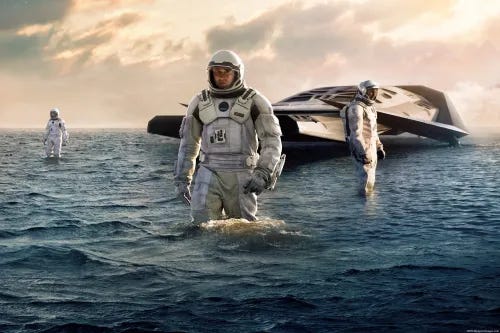
This September, we’ve paired with Cecilia Fiona and her exhibition Spirals Gathering, Time Breathing to present Interstellar at Cine Club. One of my favourite things about doing these pairings with artists is that it gives me the chance to program a film that might not fit in with other films in a season. In this instance, I’m a huge fan of Interstellar and have travelled multiple times to see it projected on 70mm in cinemas, but I think that that sort of cinephile fandom is exactly what made me unsure if we’d ever screen it. Interstellar, as with all Christopher Nolan films, is one that inspires a great deal of conversation around viewing format. I love our little cinema at Towner, but we don’t have celluloid projection, it isn’t an IMAX, it’s just a humble little screen. However, seeing how The Odyssey has played here made me realise that format only matters so much. With Nolan’s films, you just have to see them the best way you can. Seeing a film in the cinema, any cinema, is still a phenomenal way to see it.
So why Interstellar then? What makes it special? I think, reputationally if nothing else, this is the most interesting Christopher Nolan film. It feels like the most divisive one, despite the fact that it features highly on both the Letterboxd and IMDB highest rated film charts, but I think that’s the healing power of time. The initial critical reaction was pretty mixed, with Nolan coming off of the end of his Dark Knight trilogy and not too long after the hit that was Inception. Nolan himself was openly drawing comparisons to 2001: A Space Odyssey and I think it must have been some combination of those things that meant massive expectations got in the way of appreciating Interstellar for what it is. Peter Bradshaw at the time called it Nolan’s “biggest event, biggest spectacle, biggest pastiche, biggest disappointment.” Not damning the film exactly, but certainly not as impressed with it as he wanted to be, which is indicative of much of the wider response.
And yet, we have this reappraisal. You could easily attribute that to people seeing through the initial hype and impressions to see the film as it is, but I think it’s less about seeing the film as it “truly” is (can such a thing ever exist?) and more about perspective. You see, a lot of the talk at the time of release was really specifically narrowing in on the scientific accuracy of the film, and that’s just the kind of approach that I really don’t understand. There were a lot of scientists consulted for this film and the Nolan brothers did try and be accurate, but I think critiquing the film based on its inaccuracy is just missing the point. Despite its appearance, this is a film to be watched like a lot of my favourite surrealist films, which is to say it’s a film to watch with your heart, not your mind. The emotional thesis by the end of the film ends up being something like “love is the fifth dimension and stronger than time”, which is patently ridiculous until you feel it in action. That feeling also has a cumulative effect. The first time I cried at this film was the third time I saw it, another thing that seems ridiculous until you’re in the same position.
When Cecilia suggested this film for the screening, I initially didn’t understand the connection. Interstellar is one of my favourite films, so I knew what I saw in it, but I didn’t know what connected it to her art. I’ve not yet had the chance to discuss it with her, but having thought about it further, I don’t think it is such an odd connection. I think her art has a similar impact on me, in that the craft and creation of it is absolutely immaculate, but I narrow in on the emotional impact. There’s something sublime, in the gothic sense, about both her work and Interstellar. They’re huge, yet fully thought through, in a way that makes my head spin a bit. You could certainly pick a weirder film to pair with her exhibition, but I think Interstellar is a far better fit than it has any right to be.
I enjoy looking back at Interstellar ideologically too, just as an anthropological thing. The central thrust of the narrative is about abandoning Earth and trying to find a new planet to live on. I love that I can love a film so much when I so completely disagree with its thesis. This was a very popular idea about a decade ago, that interplanetary travel would save us, and it was popularised by a man named Elon Musk. Whatever happened to him? It’s funny that such a hopeful film is so committed to the idea of just abandoning Earth instead of giving it another shot, but again, it’s an interesting anthropological note for me that I always enjoy mulling over and relish not having to agree with.
Finally, one of the things I love about Interstellar in 2026 is how it marks a change in Nolan’s filmmaking. This was the first film Nolan made with cinematographer Hoyte van Hoytema, parting ways with Wally Pfister. If you’ve never seen a picture of van Hoytema, he is massive, which I mention only because with Interstellar, Nolan makes even more use of the IMAX cameras he started using on The Dark Knight. Those cameras are immense and I don’t think it’s a coincidence that Nolan had to get a big muscly cinematographer to lug those around. Fortunately, van Hoytema is also a real talent and has an eye for photographing the impossible, he makes everything look so special, especially when it’s a thing that shouldn’t exist. It’s also one of the last times Nolan would work with Hans Zimmer, and this may be one of Zimmer’s crowning achievements. Even if you’ve not seen the film, you’ll doubtless have heard his music, it has become almost commonplace because of its brilliance. It is a massive source of momentum for many of the action scenes in the film, but also brilliantly left absent for moments of tension. Zimmer’s collaboration with Nolan is one of his best, and this might be my favourite.
Whatever you may make of Interstellar today, I think it’s a brilliant middle point between Nolan’s early headscratcher films and his current era of epic and singular visions, all held together by a properly moving emotional core. It feels special because in the world of blockbusters, this isn’t what these films look like. If you love sci-fi, you love how this looks, how this moves and how it makes you feel. And while it’s a fantastic film watched at home on a blu-ray, I cannot emphasise enough that you have to try and see it in a cinema as soon and as often as you can.
If You Like This, You’ll Like…
Films:
Fantastic Planet (1973, dir. René Laloux) – If you really enjoyed Cecilia Fiona’s exhibition and wished it had been paired with a far stranger film, I cannot recommend Fantastic Planet enough. It’s animation Jim, just not as we know it, exploring a very strange alien world in ways both surreal and delightful.
Arrival (2016, dir. Denis Villeneuve) – For a companion sci-fi film from the last decade, I cannot recommend highly enough Arrival, the most thrilling film about linguistics and translation that you will ever see. To say more would ruin what is an incredibly special and singular film.
Video Games:
Outer Wilds (2018) – What would it feel like to explore space? To be the one charting new planets and discovering new life for the first time? No video game has ever answered that question with as exhilarating a sense of discovery as Outer Wilds, a game in which exploration is the greatest reward of all.

