Introduction

Introduction to Interstellar

Hello! In a subtle way, this is an incredibly important edition of Cine Club, as it’s our one year anniversary! I feel very humbled and very grateful to be allowed to program and introduce films not just as a one off thing but now as a regular part of a cinema’s program. It’s wonderful, and I appreciate everyone who has had any part in its existence, be they attendees, colleagues or family and friends. If you want to be supportive too and are free tonight, tickets are still available! Maybe you can’t make tonight, or you prefer your films a little more left field, in which case I would love to preview our next season for you. To close out the year, we’re screening films under the umbrella of “Elastic Reality”, films which stretch the understanding of our worlds. I think it’s a phenomenal batch, we’ve got Eraserhead in October, Burning in November and Petite Maman in December, all are well worth your time and I personally think it would be really awesome and cool if you came along!
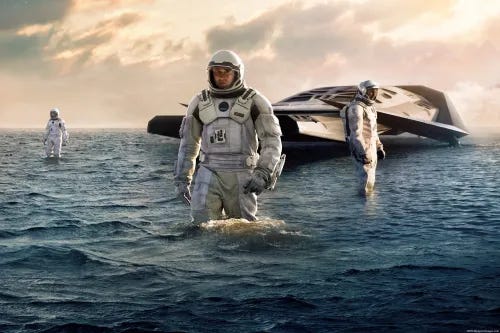

Towner Cine Club: Interstellar

This September, we’ve paired with Cecilia Fiona and her exhibition Spirals Gathering, Time Breathing to present Interstellar at Cine Club. One of my favourite things about doing these pairings with artists is that it gives me the chance to program a film that might not fit in with other films in a season. In this instance, I’m a huge fan of Interstellar and have travelled multiple times to see it projected on 70mm in cinemas, but I think that that sort of cinephile fandom is exactly what made me unsure if we’d ever screen it. Interstellar, as with all Christopher Nolan films, is one that inspires a great deal of conversation around viewing format. I love our little cinema at Towner, but we don’t have celluloid projection, it isn’t an IMAX, it’s just a humble little screen. However, seeing how The Odyssey has played here made me realise that format only matters so much. With Nolan’s films, you just have to see them the best way you can. Seeing a film in the cinema, any cinema, is still a phenomenal way to see it.

So why Interstellar then? What makes it special? I think, reputationally if nothing else, this is the most interesting Christopher Nolan film. It feels like the most divisive one, despite the fact that it features highly on both the Letterboxd and IMDB highest rated film charts, but I think that’s the healing power of time. The initial critical reaction was pretty mixed, with Nolan coming off of the end of his Dark Knight trilogy and not too long after the hit that was Inception. Nolan himself was openly drawing comparisons to 2001: A Space Odyssey and I think it must have been some combination of those things that meant massive expectations got in the way of appreciating Interstellar for what it is. Peter Bradshaw at the time called it Nolan’s “biggest event, biggest spectacle, biggest pastiche, biggest disappointment.” Not damning the film exactly, but certainly not as impressed with it as he wanted to be, which is indicative of much of the wider response.

And yet, we have this reappraisal. You could easily attribute that to people seeing through the initial hype and impressions to see the film as it is, but I think it’s less about seeing the film as it “truly” is (can such a thing ever exist?) and more about perspective. You see, a lot of the talk at the time of release was really specifically narrowing in on the scientific accuracy of the film, and that’s just the kind of approach that I really don’t understand. There were a lot of scientists consulted for this film and the Nolan brothers did try and be accurate, but I think critiquing the film based on its inaccuracy is just missing the point. Despite its appearance, this is a film to be watched like a lot of my favourite surrealist films, which is to say it’s a film to watch with your heart, not your mind. The emotional thesis by the end of the film ends up being something like “love is the fifth dimension and stronger than time”, which is patently ridiculous until you feel it in action. That feeling also has a cumulative effect. The first time I cried at this film was the third time I saw it, another thing that seems ridiculous until you’re in the same position.

When Cecilia suggested this film for the screening, I initially didn’t understand the connection. Interstellar is one of my favourite films, so I knew what I saw in it, but I didn’t know what connected it to her art. I’ve not yet had the chance to discuss it with her, but having thought about it further, I don’t think it is such an odd connection. I think her art has a similar impact on me, in that the craft and creation of it is absolutely immaculate, but I narrow in on the emotional impact. There’s something sublime, in the gothic sense, about both her work and Interstellar. They’re huge, yet fully thought through, in a way that makes my head spin a bit. You could certainly pick a weirder film to pair with her exhibition, but I think Interstellar is a far better fit than it has any right to be.

I enjoy looking back at Interstellar ideologically too, just as an anthropological thing. The central thrust of the narrative is about abandoning Earth and trying to find a new planet to live on. I love that I can love a film so much when I so completely disagree with its thesis. This was a very popular idea about a decade ago, that interplanetary travel would save us, and it was popularised by a man named Elon Musk. Whatever happened to him? It’s funny that such a hopeful film is so committed to the idea of just abandoning Earth instead of giving it another shot, but again, it’s an interesting anthropological note for me that I always enjoy mulling over and relish not having to agree with.

Finally, one of the things I love about Interstellar in 2026 is how it marks a change in Nolan’s filmmaking. This was the first film Nolan made with cinematographer Hoyte van Hoytema, parting ways with Wally Pfister. If you’ve never seen a picture of van Hoytema, he is massive, which I mention only because with Interstellar, Nolan makes even more use of the IMAX cameras he started using on The Dark Knight. Those cameras are immense and I don’t think it’s a coincidence that Nolan had to get a big muscly cinematographer to lug those around. Fortunately, van Hoytema is also a real talent and has an eye for photographing the impossible, he makes everything look so special, especially when it’s a thing that shouldn’t exist. It’s also one of the last times Nolan would work with Hans Zimmer, and this may be one of Zimmer’s crowning achievements. Even if you’ve not seen the film, you’ll doubtless have heard his music, it has become almost commonplace because of its brilliance. It is a massive source of momentum for many of the action scenes in the film, but also brilliantly left absent for moments of tension. Zimmer’s collaboration with Nolan is one of his best, and this might be my favourite.

Whatever you may make of Interstellar today, I think it’s a brilliant middle point between Nolan’s early headscratcher films and his current era of epic and singular visions, all held together by a properly moving emotional core. It feels special because in the world of blockbusters, this isn’t what these films look like. If you love sci-fi, you love how this looks, how this moves and how it makes you feel. And while it’s a fantastic film watched at home on a blu-ray, I cannot emphasise enough that you have to try and see it in a cinema as soon and as often as you can.


If You Like This, You’ll Like…

Films:

Fantastic Planet (1973, dir. René Laloux) – If you really enjoyed Cecilia Fiona’s exhibition and wished it had been paired with a far stranger film, I cannot recommend Fantastic Planet enough. It’s animation Jim, just not as we know it, exploring a very strange alien world in ways both surreal and delightful.

Arrival (2016, dir. Denis Villeneuve) – For a companion sci-fi film from the last decade, I cannot recommend highly enough Arrival, the most thrilling film about linguistics and translation that you will ever see. To say more would ruin what is an incredibly special and singular film.

Video Games:

Outer Wilds (2018) – What would it feel like to explore space? To be the one charting new planets and discovering new life for the first time? No video game has ever answered that question with as exhilarating a sense of discovery as Outer Wilds, a game in which exploration is the greatest reward of all.

Standard
Introduction

Introduction to The Seashell and the Clergyman by Germaine Dulac

Hello! This was an introduction I wrote for the inaugural Breakfast Film Club screening at Towner Eastbourne on 14th June 2025. It all went well and we had a lovely time, with two more screenings coming up over the Summer. For preservations sake and for those who weren’t able to attend, you’ll find my script below for my intro. It is rough and ready as I was using it as a basis but hopefully you’ll enjoy it for what it is!

Good morning and thank you so much for coming out to our inaugural Saturday Breakfast Film Club! My name is Henry Jordan and I’m one of the duty managers here at Towner. I do a lot of work alongside the cinema here so you may have seen my face around. I’m also a freelance writer and I have a first class degree in Film Studies and English from University of Exeter, where I specialised in contemporary literature and surrealist films. 

Today, we’re screening a selection of films from the filmmaker Germaine Dulac, starting with The Seashell and the Clergyman before her short films Themes and Variations, Cinegraphic Study on an Arabesque and Disque 957. Dulac began making films before wide understanding of the word surrealism, hence why she is often referred to as both an abstract and a surrealist artist, fitting into both, either and neither categories. For those who may not know, Surrealism itself is first coined as a word in 1917 by Guillaume Apollinaire, though we really start thinking of Surrealism as a movement in 1924 with the publishing of the two manifestoes of Surrealism. The first is released by a school of artists who claim to be successors to Apollinaire, and the second, released just two weeks later, is spearheaded by Andre Breton alongside artists like Man Ray, Salvador Dali and Marcel Duchamp. It is Breton’s we typically refer to these days, as the language of his manifesto is both the most potent and the most malleable of the two. You may already be familiar with Breton’s definition of Surrealism, in which he describes the movement as art that evokes “the actual functioning of thought. Dictated by the thought, in the absence of any control exercised by reason, exempt from any aesthetic or moral concern.” 

Breton here is describing art that is expressing images and logic from the subconscious, often inhabiting the world of the dreamlike, which makes sense when you consider Surrealism’s precursor Dadaism, a movement centered around nonsense and no-sense, as well as the growing popularity of the work of Sigmund Freud and his psychoanalysis of dreams. Breton’s description of surrealist art as dreamlike is still one of those ideas that has transcended to today, it’s often one of those things that causes us to see a film and go “that was a bit surreal”. However, I do want to complicate Breton’s idea that this was art exempt from “moral concern”. These manifestos are written by outsiders, but still outsiders who were wealthy white men. They felt no need to engage in the moral concern of politics, which is obviously a stance that is retroactively worrying in 1920s Europe. If you’re coming to the screening of Daisies, put a pin in that idea of Surrealism as being exempt from any moral concern, Chytilová’s film is very engaged with ideas of moral concern, in between the food fights and beheadings, though I suppose to some that is of concern.

It is worth remembering about the earlier days of the Surrealist movement that it is very male. There are female artists and gender non-conforming artists who exist and make great art but are left by the wayside as this boys club starts to really pick up steam. Surrealism gets stuck in the thing that many art movements do, where the men are the artists, the women are the muses and ironically for a movement that is so focused on upending convention, there is little room for fluidity in that. I’ll offer some further recommendations before we begin the screening but this regressive attitude meant that works by great artists like Claude Cahun, Leonora Carrington and Maya Deren have required critical revaluations over the century, usually after the artist’s death, to reach the esteem they are now held in. Even today, you see this erasure. While trawling YouTube, I found that someone had commented under one of Dulac’s shorts how much they love Jean Cocteau, and are rightly corrected that while Cocteau’s work is wonderful, he has nothing to do with the project. Fortunately, today we do get to celebrate an artist who did receive her flowers in her time, with Germaine Dulac. She begins making her short films before the Surrealism manifestoes are published, with her earliest known film being released in 1915, obviously complicating her place in the movement. 

Anyway, she is making shorts for the next decade or so, including an adaptation of The Lais of Marie De France, but the films we’re watching today are all from the tail end of the twenties. When she released The Seashell and The Clergyman in 1928, she released it one year before Un Chien Andalou, hence why hers is often considered the first true Surrealist film as it predates the most influential. The title is contentious, not least because Dulac comes from the world of the cinematic Impressionists and not the Surrealists, but it hopefully puts into perspective for you how groundbreaking the films you’re about to watch are. Ironically, even at the time the film was overshadowed by Bunuel and Dali’s film, despite the fact that techniques that Un Chien used and was praised for using also appear in Dulac’s film. Still, there is some consolation, in that even the criticisms of the film accurately appraise Dulac’s work. The British Board of Film Censors, better known today as the BBFC, reported that the film was “so cryptic as to be almost meaningless. If there is a meaning, it is doubtless objectionable”. When you’re viewing the films today, see how doubtlessly objectionable you find the meaning.

For me, I think they pull this idea of objectionability from the abstraction of the body. We’re not quite in the era of film censorship here but we see in Seashell similar tactics, in which ideas are explored through metaphor and allusion. We’re presented with these opposing images, with the phallic power of the sabre and the yonic draw of the seashell in frequent contrast to each other. Perhaps Dulac simply liked sword fighting and enjoyed trips to the seaside. Perhaps you too find these images objectionable. With surrealism, there is only one answer that matters and it’s the answer you feel.

Once synchronous sound made its way into cinema, Dulac drifted away from the medium, mainly making newsreels for companies like Gaumont and Pathe. However, she was awarded the Legion of Honour in 1929 for recognition of her contributions to the French film industry. It would be many years until her work was as well respected internationally as it was nationally but it remains an important footnote, that she did receive the highest honour that a French citizen can receive for her work, and did so while in the height of her career.

So, what does this have to do with Paule Vezelay? Well, let me draw your attention to the quote that greets you when entering the exhibition. Vezelay says of her art “I hope to give intense pleasure to the eye of the beholder… (with) colours and forms more pleasing than can easily be found in actuality”. Though Vezelay was not a surrealist, of course neither was Dulac, so it feels harmonious that their works made alongside Surrealism can be drawn together by the strands of the movement. You’ll see this aspect more in the short films at the end of this program, in which Dulac really does get abstract with shape and form, creating the illusion of movement through a form in which that illusion is no longer required. I love that idea Vezelay brings up though, of colours and forms more pleasing than can be found in actuality. That’s the magic of cinema in it’s purest form, in getting to experience pure visual pleasure for nothing more than the sake of pleasure. These films today are a very refined version of that and it’s a form of pleasure in cinema that I think we often lose once cinema chains itself down with narrative, sound and character.

Alongside the visual pleasure, I encourage you to explore the film through these themes, of gender power dynamics, of sexuality, of dream logic. I also encourage you to detach from this if you want. I love surrealism because of the emotional sense it makes to me and I implore you, if it stops making narrative, thematic or structural sense to you, explore the film emotionally.

Before I wrap up, one of the things that I think is so wonderful about this screening today is the soundtrack that is going to accompany it. The Seashell and the Clergyman is part of this era of film we call silent film, but none of these films were ever truly silent. They didn’t have synchronous sound until the late 1920s and even then, it took a while for cinemas to get fitted for this new technology. So, before the “talkie”, cinemas experimented. Many would have their own in-house musicians who would play music live to accompany the film, and we still see the relics of this in touring artists like The Dodge Brothers and Hugo Max or in the preservation of instruments like The Mighty Wurlitzer Theatre Organ in the Tampa Theatre in Florida. However, many would simply do as we are doing and play music off a record. Today, we’re lucky enough to have music from the band In The Nursery, who have made many musical accompaniments to silent films as varied as Man With a Movie Camera and The Fall of the House of Usher. Their score for Seashell is really special and has helped enrich my own appreciation of the film. The score was released in 2019 and so it is decidedly modern, owing a clear debt to David Lynch’s longtime collaborator Angelo Badalamenti, whose work you may know from Twin Peaks and Mulholland Drive. The score is a mercurial thing, that has elements of threat but also elements of beauty and something unattainably grand. In concert with the images on screen, it makes something magical and again, if you feel the film losing you, lean into the music and you will find yourself returning before long.

If you want any quick recommendations of where to go after this viewing, I would always recommend the short films of Maya Deren, particularly her seminal Meshes of the Afternoon, and if you’re after more silent surrealism, The Life and Death of 9413, A Hollywood Extra, also from 1928, is a delight. Honestly though, this is such a fruitful era for Surrealism, you could pick any name I’ve mentioned today, zero in on them and vanish down a dreamy rabbit hole.

We’re really excited to be programming this selection of films to enhance your experience with our current exhibitions of Sussex Modernism and Paule Vézelay Living Lines. Whether you’ve already seen the exhibitions or you’re planning to after this screening, I hope that these films compliment your time upstairs and vice versa. If you enjoy today’s screening, please do tell your friends and do also tell us! We have two more of these screenings currently on sale if you’re interested in seeing more. One is for Borderline on 12th July which will be introduced by Dr Hope Wolf, who has curated our Sussex Modernism exhibition, and the other is Daisies on 13th September, which will again be introduced by me. These have all been organised and put together by my colleague Emily Medd, she’s done a fantastic job getting all the moving pieces together and we wouldn’t be doing any of these screenings without her. If you enjoy them, hopefully that gives us the chance to put on even more of these with future exhibitions, so please do talk to us after the screening. But for now, please. Get comfortable, get ready and get excited for Germaine Dulac and her cabinet of abstract delights.

Standard