
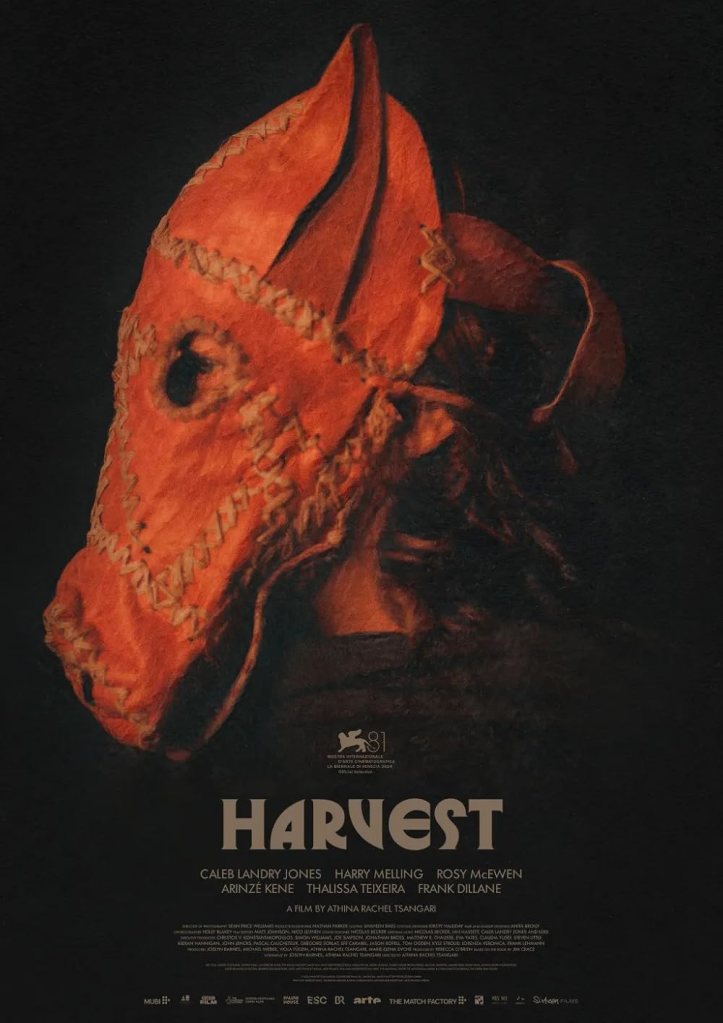
For those of you who don’t base their entire lives around film and are based near (enough) to London, you may not know that this week is the start of the 2024 London Film Festival! After a quieter edition for me last year while I moved house, I am back on it this year, using a press pass to its fullest in ways that my sleep schedule does not appreciate. You join me on day two and after five films, I’ve already got one to share with you that is very special. That film is Harvest.
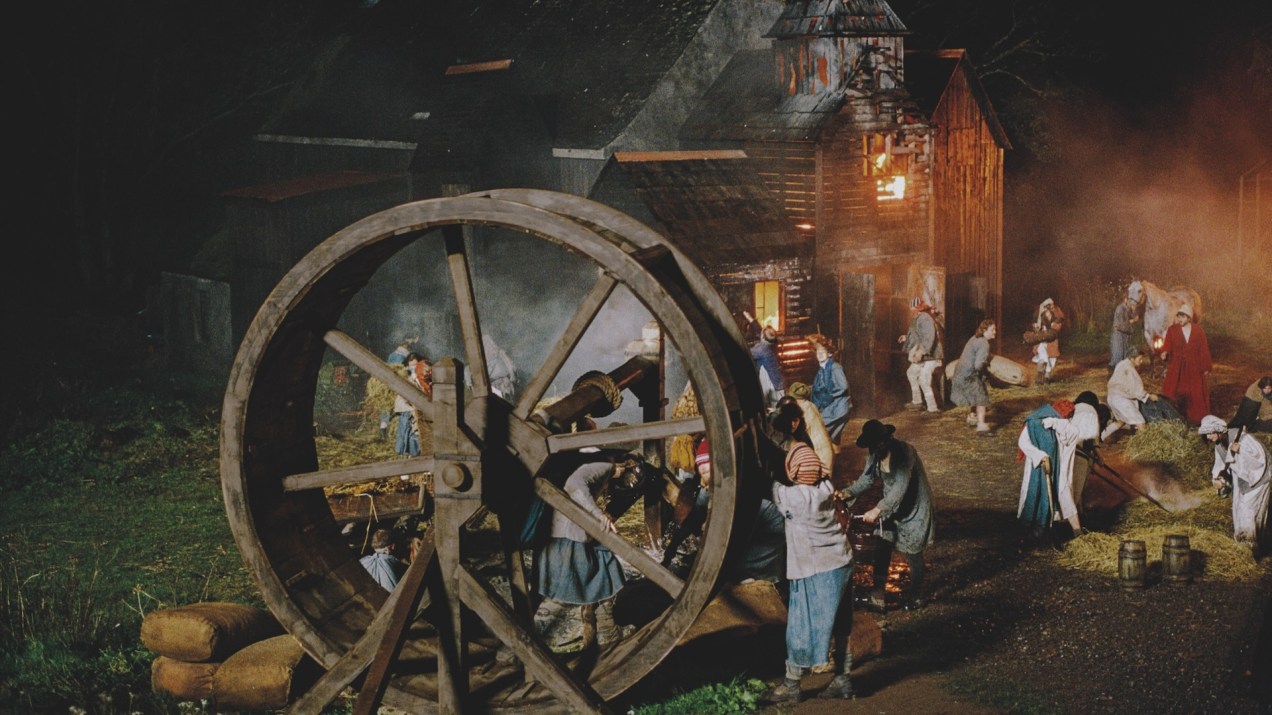
Harvest is the third film from Greek director Athina Rachel Tsangari and her first in the English language. In the film, villagers from a place of ambiguous location (but probably in Scotland) during an ambiguous time period find their lives falling apart at the same time that they are visited by outsiders. First a barn burns down and three strangers face the blame for it, finding themselves humiliated by the villagers. Then fingers start to be pointed at the cartographer who has recently appeared to capture the landscape. Soon though, things take an even greater downward turn as we meet the cousin of the Lord of this village, a man who has his own view on what the future of this village is. That is the broad strokes of the plot and in between those strokes, it doesn’t get much more detailed. That’s the charm of Harvest though, it’s properly mercurial. Eventually, you’ll find out who burned down the barn, but you’ll never know why they did it. At a point, you’ll find out why the strangers arrived, but it’s a real loose reason. You won’t ever understand what main character Walter’s deal is, but that’s a-ok with me. This is all fable, loose events that come together to explain how a village disappeared in the space of a week.
I’ve mentioned Walter, so let’s get into the cast, which was mainly actors I didn’t know. As Walter is Caleb Landry Jones, an actor I’ve known and liked for a while. He’s been in everything from Get Out to The Florida Project and Twin Peaks: The Return, even appearing in things I love that aren’t from 2017. Here, he gets one of his rare leading roles, properly embodying this creature married to his world. We learn a little about his history but never enough to truly understand him. Everything else you have to attempt to glean from Jones’ performance and good luck finding purchase on his slippery work. The cast around him are superb too. Harry Melling continues to distance himself from the Harry Potter franchise with another brilliant performance, effortlessly embodying a man with power who doesn’t really believe his power. He’s pathetic and that’s fantastic. Also fab are Rosy McEwan (who really makes me feel guilty for having still not seen Blue Jean), the perpetually underrated Arinzé Kene and a deliciously villainous turn from Frank Dillane. It’s such a great ensemble, with no one seeming out of place unless that’s exactly what they’re meant to do.
What [Williams] is doing, it turns out, is magic
While you get a sense of the performances and narrative over time, Harvest does its best to immediately strike you as strange. Tsangari comes from the Greek Weird Wave and despite tackling a Scottish period drama, she keeps the weird flowing here. What struck me first was the score, this bizarre prog rock inspired thing that immediately tells you all is not as it seems. Throughout, it veers in and out of the expected, hitting the usual strings of period dramas before heading straight back to prog rock nonsense. Pair that with the cinematography by Sean Price Williams and something special happens. You see, Williams is a cinematographer associated with the mumblecore of Alex Ross Perry and who also shot the brilliant Good Time. What is he doing on a period drama? What he is doing, it turns out, is magic. The camera is this little handheld 16mm thing, being chucked around the village and getting right up into the chaos that ensues, at one point even taking to the sky for a drone shot. Unbelievably, Williams even recreates a version of my favourite shot from Good Time, which sounds impressive before I tell you that the original shot involves a neon sign. Together, both sound and vision create an “out of place”-ness that pervades and absolutely refuses to let you be comfortable at any point during the film.
Another thing that prevents you feeling comfortable is the amount of reference points your brain will be bouncing between. The aforementioned cinematography goes away from Williams’ mumblecore roots to more closely resemble modern day Terence Malick. Where Malick uses his swooping camera to make profound statements on the world, Tsangari uses it to disorient and make you feel gross. It’s a simple swap but one that never failed to throw me off. I also kept thinking of a video game called Pentiment, a handy touchstone for any who are familiar. In the game, you are an artist in 16th century Bavaria who arrives in a small town and becomes embroiled in a murder mystery. One of the joys of that game is the sense of failure, in that you will accuse people of committing crimes and have no idea if you were right until after they are punished for these crimes. Another joy is this feeling of the modern hurtling towards the town, threatening to crush it underfoot. Both those and the anarchic humour played on my mind in Harvest and while I don’t take Tsangari as a gamer, I think it’s a useful reference point for an audience member approaching the film as far as tone and plot. The future is inevitable, but how will the unwashed masses face it?
My favourite thing about Harvest came packaged inside the building sense of tension that the film bestows unto you, which is this veiled critique on capitalism and the modern. If I may dust off my degree for a moment, there was a fantastic course I did on Transatlantic Literary Relations, in which we got pretty into the weeds about the roots of capitalism and what would become late capitalism. One of the things that I learned on the course was how maps can be a tool of the coloniser, placing a country in the centre of a map and artificially shrinking those who are to be colonised. It was a really striking revelation that stuck with me and still shapes how I see the world today, which again meant that Harvest set my brain racing. Quill, the cartographer, is a skilled artist of his craft and makes beautiful maps. However, these are a people without maps and the question starts to arise of what the purpose of these maps could be. I’ll not spell it out for you but it was this absolutely sick moment of “oh, that’s what this film is going to talk about” that made me start grinning ear to ear in the screening room. What a great surprise, what a treat of a turn in the tale. Sure, it’s an angle that is quite specifically up my street, but it’s only one puzzle piece of many in a film that is outstandingly rich.
I feel like I’ve barely scratched the surface of Harvest. I’ve not touched on the ritualistic nature of the villagers, talked about one of the most chilling character introductions where nothing actually happens, nor mentioned the strangest waterboarding scene I’ve ever witnessed. Instead, I leave these as gifts for you. As someone who didn’t particularly enjoy Tsangari’s previous film Chevalier and is yet to see her debut Attenberg, my expectations here were blown out of the water. Harvest is special, a rich film that is immediately rewarding and yet promises more if you let it inside. It currently doesn’t have a UK release date but it will be distributed by MUBI and I can only beg that you go and seek the film out as soon as it appears. I thought it was a real treat and the idea of there being films I might like more than this at LFF makes me practically giddy. Harvest left me intoxicated and deluded and I am grateful beyond words for that blissful experience.
 The Quite Nerdy Blog