
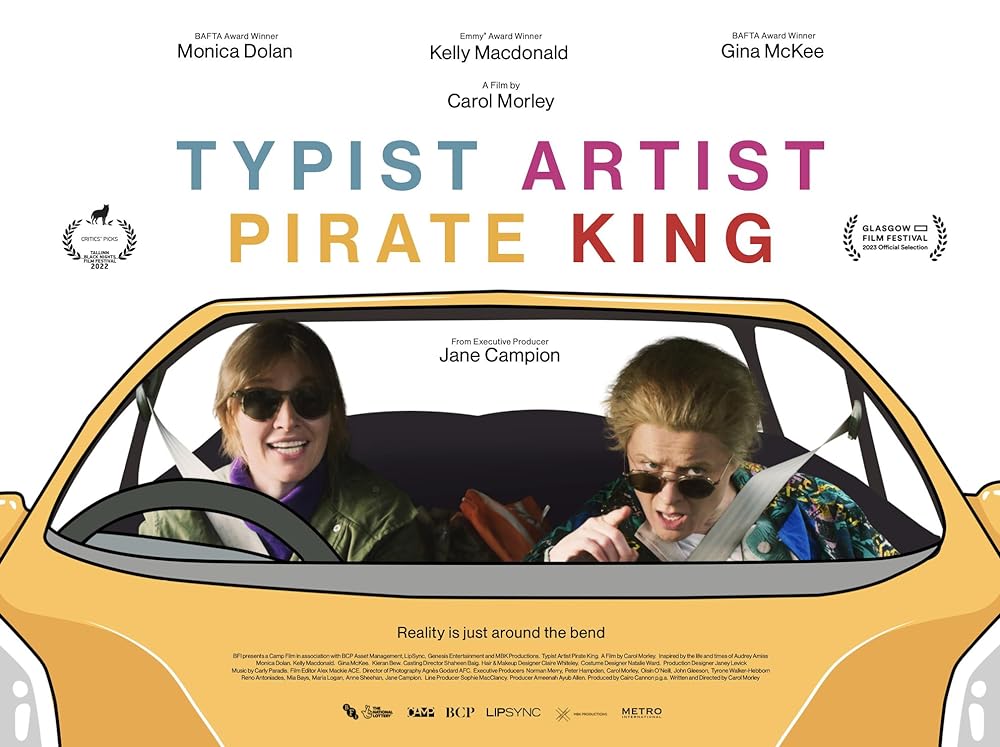
So, this is a tricky review to write. I was very excited for Typist Artist Pirate King. I like Carol Morley’s most recent films, she’s got a solid little cast full of talented British actors assembled here and hey, a film about outsider artists who went underappreciated in their time is exactly my kind of bullshit. Even having heard negative reviews from people, it couldn’t deter me from seeing Typist. In hindsight, I should have let myself be deterred.
For those, presumably many of you, who don’t know what this film even is, let me do that thing we’re meant to do at the start of reviews and spell out the facts of what the film is. Our lead character is Audrey Amiss, a real life artist who suffered with what I believe the film states is paranoid schizophrenia. The exact details are unfortunately unimportant, as they only amount to the background detail of Audrey having been in and out of institutions for her whole life, and to the ongoing detail of her having schizophrenic episodes in which she mistakes people in front of her for people in her past. The story surrounding her is completely fictional however, a story in which she and her ex-carer take a road trip to Sunderland to enter Audrey’s work in a gallery.
Theoretically, good idea! The road movie is this mythical genre that doesn’t get many entries and it gets even fewer British ones (Radio On and The Trip feeling like the only major examples unless you want to be generous and chuck in Chitty Chitty Bang Bang), so yeah, let’s throw another film into the mix! The problem with a bad road movie though is exactly the same as a bad road trip; it can start well but soon you start to realise you don’t know where the destination is. I’ve seen quite a few “aimless” movies recently which create a delightful aura to luxuriate in but Typist is a film that unfortunately deserves the title of aimless with all the negative connotations it encompasses. Though you know early on that the goal is Sunderland (and Lord, what a miserable goal to have), the hijinks that ensue become tiresome and you start to wonder what the point is.
I think part of this is deliberate? Throughout, there are numerous Don Quixote references (Kelly Macdonald’s character is literally credited as “Sandra Panza”), but they’re numerous to the point that even I, someone who hasn’t read or even seen an adaptation of Quixote, felt like I was being hit over the head. And again, even as a layman (with an English degree, to be fair) I understand why it’s a parallel you’d draw. Both are stories about individuals with rocky mental health, in which said individual is the head strong one leading a largely unwilling companion across the country, but I don’t think Morley has created the British Don Quixote here. That’s a stupidly large bar to set yourself, especially when your previous films have been “good, but…” It’s not an ambition I resent but it’s one that I think kneecaps a film that would have been well served with less references that seem placed largely to justify extended flights of fantasy.

If we want to chuck another positive in, I really like this cast! I don’t love what they’re doing but they’re all actors I am happy to see more of! Playing Audrey is Monica Dolan, one of our country’s most underrated actresses. She had a haunting turn in the Black Mirror episode Loch Henry earlier this year, got to play in one of the most interesting Inside No. 9 episodes and was great in Pride. She’s one of those “it’s them! From that!” actors, a crop that keep getting work because they are chameleonic in their approach and damn good at what they do. I think Audrey is a very difficult character to inhabit though. She has to be irrational and somewhat unlikable by design, while still being empathetic enough to root the emotional core of the film. To be blunt, I don’t know if it’s possible with this script but Dolan gives it her all. It’s not a performance that’s likely to be talked about long into the future, but you can’t deny that one of the best and hardest working actresses in Britain is once again giving it her all, even when she could get away with a fraction of her best.
Supporting Dolan on screen is Kelly Macdonald, another actress who has kept working and working hard over the last thirty years. Many (myself included) will have never forgotten her turn in Trainspotting but Macdonald has never rested on that laurel and starred in plenty of other iconic films, delivering in her roles the exact tone that the film requires of her. This will not be one of those. She is warm and certainly not doing bad work here, but it’s absolutely nothing remarkable. Sandra only has the levels of frustrated, pleased and the uninteresting zone between the two, which Macdonald hits easily, almost seeming annoyed that the film isn’t asking more of her. At least she spends the entire film in sweat pants and was therefore probably really comfortable while filming. The rest of the cast flit in and out, including a weirdly underutilised Gina McKee, and then the film ends. That’s it. People turned up, did something for a day or two and then got paid. Cool.
My big issue with the film boils down to its tone. Broadly speaking, the film is a comedy, I think. Obviously I didn’t make the film so I don’t know what the intent was but I did watch the film and in my humble opinion, that counts for something. Early on in the film, this light plinky plonk music and bemused looks from characters encourage the audience to laugh at Audrey, which extends into encouraging the audience to laugh at her during her psychotic episodes. They start relatively light but get much darker, except because the audience has already been conditioned to laugh they kept laughing as these moments got darker. To me, that feels wildly insensitive and makes light of a character who the film also seemingly wants us to be sympathetic for. I’m finding it genuinely hard to put into words the bizarre feeling I had in the cinema, where I was becoming really concerned for Audrey as everyone around me was laughing at her. Whatever balance Morley was trying to aim for here, I think she missed wildly and it completely tanks the film.
I can tell that there is a well meaning spirit behind Typist Artist Pirate King, which is why I find it difficult to tear it down. I’ve seen plenty of worse films this year but they were all soulless and hollow. It’s not as easy tearing down a film that was made with heart but completely missed the mark, especially when its budget is much lower and they clearly didn’t have as much to work with. This isn’t a film that makes me completely write Morley off as a filmmaker but as someone who had liked her other films, it starts to make me question those feelings. I hope she does something better next time and that this blip is something we can all just look over and forget exists.
Thanks for popping back, I know I’ve been gone for longer than I have before. It has been, in a word, busy. I’ve left the job that has drained my time and energy and enthusiasm and moved across the country to be with someone who restores all of those. I’m going to keep trying to write bits and pieces like this because it keeps me writing and even if the bigger pieces take a back seat for a while, it’s only so I remember how to make these words appear from my brain through my keyboard and onto your screen. Regardless, I appreciate y’all, especially if you read reviews like this, for films no one has heard of. It’s very nice and I think you’re cool. Anyway, that’s it, this is the end, bye!
 The Quite Nerdy Blog